So now that you know some of the benefits of menu-planning, I thought it’d be helpful to share some suggestions for planning a budget-friendly menu. However, please remember that there is no right or wrong way to plan a menu. These are just suggestions–take what works for your family, and leave the rest!
1) “Shop” Your Cupboards
I always start menu-planning by looking in my freezer, refrigerator, and cupboards. This simple exercise often yields a great deal of inspiration.For instance, last week I discovered that I had cream cheese, canned tomatoes, and noodles on hand. So I made this lasagna as part of Freezer Cooking Day.
Maybe you open up your freezer and find chicken and frozen broccoli and you open up your cupboard and see a bag of rice. Well, you have the beginnings of Chicken Broccoli Rice Casserole. Just add cheese and cream of chicken soup to your grocery list (or make your own Homemade Cream Soup) and you have everything you need for one dinner that week.
One great resource for coming up with recipes based upon what you already have on hand is by using the Ingredient Search feature from AllRecipes. Type in the ingredients you have and those you don’t have, and it will pull up a list of recipes you can make.
Two other websites you can consult for recipes based upon ingredients you have on hand are SuperCook and Recipe Matcher.
2) Consult the Sales Fliers
Once you feel like you’re getting the hang of planning your menu based upon what you have on hand, you’re ready to move onto the next level of menu-planning–planning your menu based upon what’s on sale at your local store(s). This is where you really start to see the savings happening!Most grocery store chains have their weekly sale fliers available online. If not, you will often receive a copy in the mail. Or, you could even pick one up at the store if you’re going to be driving right by it.
When you’re in the middle of planning your menu and grocery list, quickly browse through these sale fliers and see if there are any exceptional deals on things you need or things you will use in the next few months. Most of the time, the hottest deals of the week are listed predominantly in the front page of the flier. Oftentimes, these front-page deals are “loss-leaders”. (“Loss-leaders” are deals which the store is actually breaking even– or losing money on! They are designed to be good enough to “bait” you into shopping at that store.)
Don’t neglect to look through the full flier, though. Sometimes there are great deals which are hidden on the middle pages. However, remember that just because something is listed in the sales flier it doesn’t necessarily mean it’s a great deal. Over time, you’ll start learning what are the “rock-bottom” prices for items you buy and how often they go on sale in your area.
3) Survey Your Coupons
Once I’ve gotten a good idea of what I have on hand and what’s on sale at my nearby stores, I pull out my coupon box to match up coupons with the sales and see if I have any other coupons I want to be sure and use (such as high-value coupons or coupons for free items). I put these coupons in a stack and then it’s time to make my menu plan–which we’ll talk about in more detail in the next post in this series.You’ve “shopped” your cupboards, consulted the sales fliers and surveyed your coupons, now it’s time to get down to business with menu-planning. But first off, let me re-iterate a very important point:
There’s not a perfect way to plan a menu.
Everyone is going to plan their menu a little bit differently. As I said yesterday, there’s no right or wrong way to menu plan. What matters is that you do it, and that it works for your family. For the record, I do it a little differently each time I plan–depending upon how much time and inspiration I have and what our plans for the week look like.Sometimes, I have lots of extra ingredients to work with, there are lots of sales, and I have numerous coupons. When that happens, it’s pretty easy to pull together a week’s worth of meals without a lot of extra thought.
I’ve found that once-a-month Freezer Cooking makes menu planning a breeze. In fact, many weeks, I can just write out breakfast, lunch, and dinner ideas on this form here, and we’re good to go for the week. I use the sheet for ideas, but I don’t necessarily follow it to a tee. In our home, flexibility and creativity is okay–provided it doesn’t mean any extra trips to the store!
However, at times, my cupboards and freezers are pretty bare, the sales are sparse, and my coupon box is relatively empty. If that’s the case, I see how much grocery money I have to work with, and I usually pull out some cookbooks to get the wheels in my head going. Or I’ll go to one of my favorite food blogs (like Tammy’s Recipes) for ideas. You can also check out Menu Plan Monday for a plethora of menu ideas from around the blogosphere.
Find a method that works for you.
You might find it helpful to take 30 minutes and make a list of 30 meals your family loves to serve as inspiration if you’re ever feeling a lack of creativity while menu-planning.Or, you could have pre-established themes for dinners each week. Tsh, over at SimpleMom, does this and here’s an example of what her Themed Menu Plan has looked like:
M0ndays - pasta
Tuesdays - soup, salad, and/or sandwiches
Wednesdays - stir fry
Thursdays - crock pot
Fridays - pizza
Saturdays - something new
Sundays - something easy
It might seem like a daunting task at first–especially if this is all new to you!–but don’t be overwhelmed. Do the best you can do and remember that it’s never going to be absolutely perfect. Over time, though, you’ll likely begin to realize significant savings just by taking a few extra steps and putting the effort forth to make a plan.
Free Menu Planning Worksheet and Grocery Shopping Lists
To aid you in your menu-planning and grocery-list-making, Joy from FiveJ’s and I put together some free downloads for you. (By the way, Joy put together a snazzy free downloads page here so you can access all the free downloads we currently have available. Enjoy!)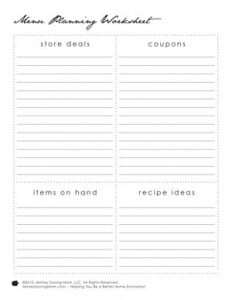
Shopping List :: Contains space for the items to purchase, the cost of the item, whether there is a coupon for it, and how much the coupon is for. Also includes a space for notes where you can record extra information about your shopping trip.
Two-Store Shopping List :: Two separate shopping lists on one page, each of which includes space for the items to purchase, the cost of the item, and whether there is a coupon for it. Also includes a space for notes where you can record extra information about your shopping trip.